Certification Standards Shaping Cluster Mechanics in Handheld-Optimized Slot Games
Riley Hayes · Jul 29, 2026
Certification Standards Shaping Cluster Mechanics in Handheld-Optimized Slot Games
Certification standards and cluster mechanics intersect directly in games built for handheld screens, where regulatory requirements dictate how symbol groupings form winning combinations and how those combinations calculate payouts on smaller touch interfaces. Providers must align cluster formation rules with approved random number generator outputs, while screen size constraints force adjustments to minimum cluster sizes and symbol density that still satisfy fairness testing protocols. In July 2026 several testing laboratories updated their handheld compatibility checklists to include specific touch-response latency thresholds that affect how cluster detection registers during rapid player interactions.
Regulatory Frameworks Governing Cluster Detection
Testing bodies evaluate cluster mechanics by examining the algorithms that identify adjacent symbols of the same type across reels or grids, and these evaluations require documented proof that every possible cluster configuration meets minimum return-to-player percentages. Laboratories such as those accredited under the Alcohol and Gaming Commission of Ontario review source code for cluster boundary definitions, ensuring no hidden patterns allow unintended symbol connections that bypass certified payout tables. Data from regulatory submissions shows that cluster size parameters undergo repeated simulation runs exceeding one billion cycles before approval, confirming statistical consistency across both portrait and landscape handheld orientations.
Technical Adjustments for Mobile Screen Limitations
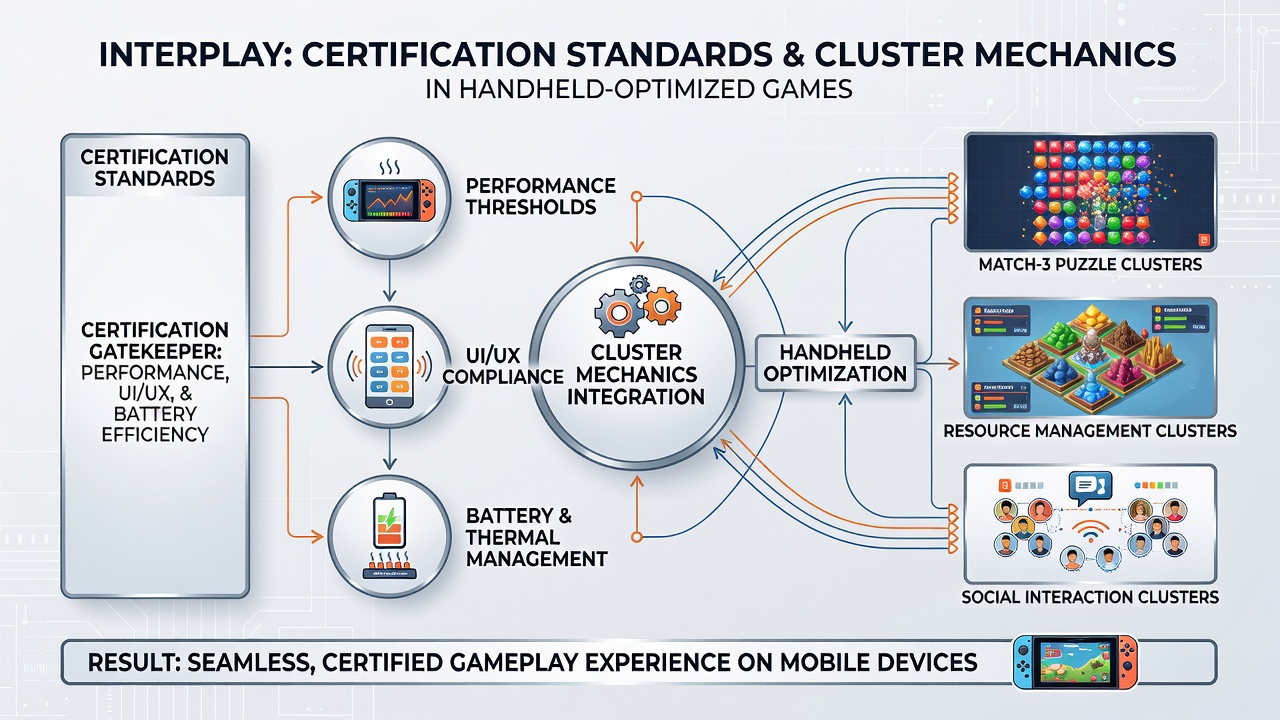
Handheld optimization introduces constraints on grid dimensions that directly influence cluster mechanics, since smaller displays limit the number of visible symbols and therefore the maximum cluster size achievable in a single spin. Developers adjust symbol spacing and highlight animations so clusters remain visually distinct under touch input, yet these visual changes must not alter the underlying probability models that certification standards protect. Observers note that games passing initial certification often require secondary mobile-specific audits because touch lag or screen refresh rates can shift the timing of cluster evaluation sequences by milliseconds, enough to trigger re-testing under updated July 2026 guidelines.
Integration of Certification Requirements with Cluster Design
Standards bodies mandate that cluster mechanics maintain identical mathematical outcomes whether played on handheld devices or larger screens, which forces studios to embed device-adaptive scaling within the same certified random number generator framework. When a cluster mechanic expands or contracts based on detected screen resolution, the expansion logic itself falls under audit because any dynamic adjustment could theoretically alter symbol weighting. Research conducted through the European Gaming and Betting Association indicates that certified cluster games released after 2025 incorporate modular payout engines that recalculate cluster values in real time while preserving the original certified RTP across all supported resolutions.
Case Examples from Recent Deployments
One deployment in early 2026 demonstrated how a cluster pays title adjusted its minimum three-symbol cluster rule to a four-symbol threshold on screens under six inches, a change submitted and approved by testing labs before market release. Another title maintained its original cluster parameters but added on-screen zoom gestures that players activate without affecting the certified outcome engine, illustrating how visual aids can coexist with unchanged mathematical models. Figures released by the Alcohol and Gaming Commission of Ontario reveal that handheld-optimized cluster titles submitted between January and June 2026 required an average of 2.3 additional review cycles compared with non-mobile versions, primarily due to touch-interface validation steps.
Conclusion
The relationship between certification standards and cluster mechanics continues to evolve as handheld hardware capabilities advance and regulatory bodies refine their mobile testing criteria. Providers who embed certification checkpoints throughout the development cycle produce games that satisfy both technical compliance and player expectations for responsive cluster interactions on portable screens. Ongoing updates scheduled through late 2026 will likely introduce further specifications for multi-touch cluster selection and cross-device outcome parity, reinforcing the need for integrated design and compliance processes.